Abstract
Recent popular science reports have suggested that “prime number patterns” might appear inside black holes. However, what lies behind this formulation is typically not a direct connection to the Riemann zeta function itself, but a deeper structural mechanism: primitive cycles in dynamical systems naturally generate zeta products whose zeros encode resonances or spectral fluctuations.
This architecture appears across many fields – from number theory to hyperbolic geometry and quantum chaos. In this article we explore the possibility that similar structures could also arise in horizon-near dynamics. Within the Frame Budget Approach (FBA), such structures can be interpreted as bookkeeping devices for irreducible budget loops in open, irreversible dynamical systems.
The resulting structural chain can be summarized compactly as:
primitive loops → zeta product → zeros → resonances → observables
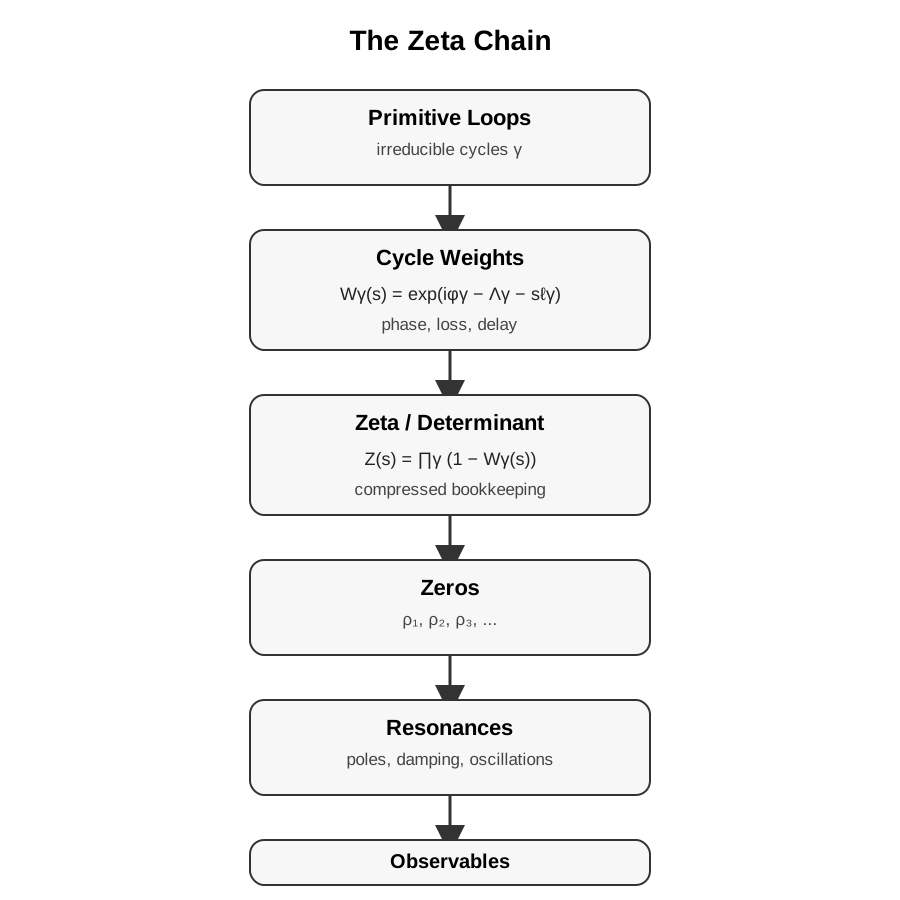
1. Starting Point: “Prime Numbers Inside Black Holes?”
Several recent papers and popular science articles have discussed the possibility that structures from number theory might appear in the context of black holes.
Examples include discussions of so-called “primon gases”, automorphic structures in BKL dynamics, or work relating zeta structures to spectral statistics and form factors in black-hole-related models.
Typical popular introductions include:
- Der Standard: “Prime Number Patterns Discovered in Black Holes”
- Scientific American: “Are Prime Numbers Hiding Inside Black Holes?”
- LiveScience: “Exotic prime numbers could be hiding inside black holes”
However, the underlying research usually refers to mathematical objects such as:
- automorphic L-functions
- Selberg zeta functions
- Ruelle zeta functions
- resonance spectra of open dynamical systems
The key question therefore becomes:
What minimal structural conditions allow zeta functions to appear in the first place?
2. The Structural Class of Zeta Functions
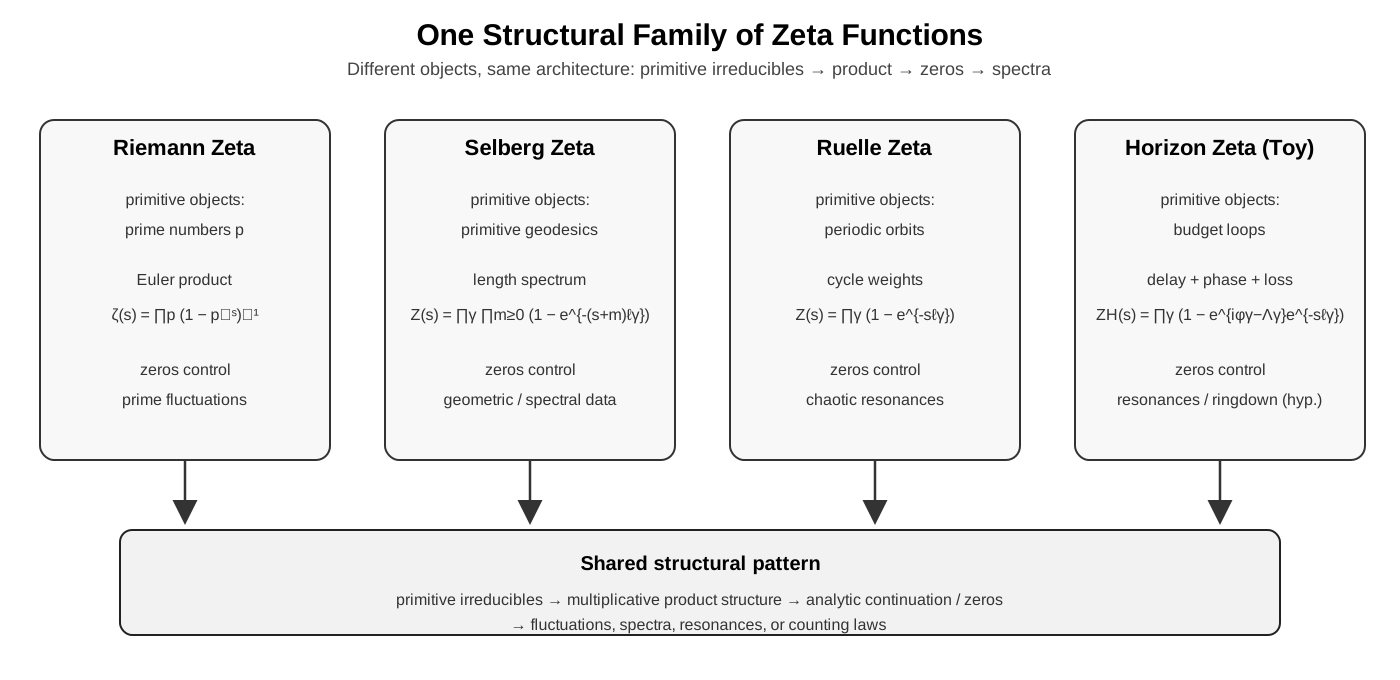
Many seemingly different mathematical objects share the same structural form:
- Riemann zeta: product over prime numbers
- Selberg zeta: product over primitive geodesics
- Ruelle zeta: product over primitive periodic orbits
In all these cases the same logic applies:
primitive irreducible objects generate a multiplicative product structure.
After analytic continuation this structure produces zeros or poles that control fluctuations, spectra, or resonances.
3. Primitive Cycles and Euler Products
If a dynamical system possesses primitive cycles, repeated traversals can be written as powers of a primitive cycle.
The sum over repetitions can then be rewritten as a product over primitive cycles.
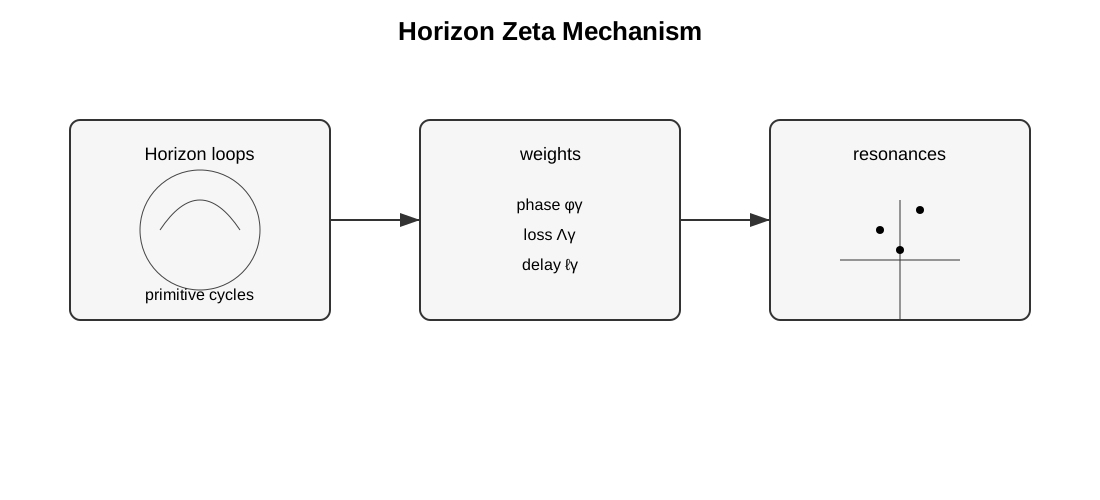
- ℓγ – geometric cycle length
- φγ – reversible phase
- Λγ – irreversible damping
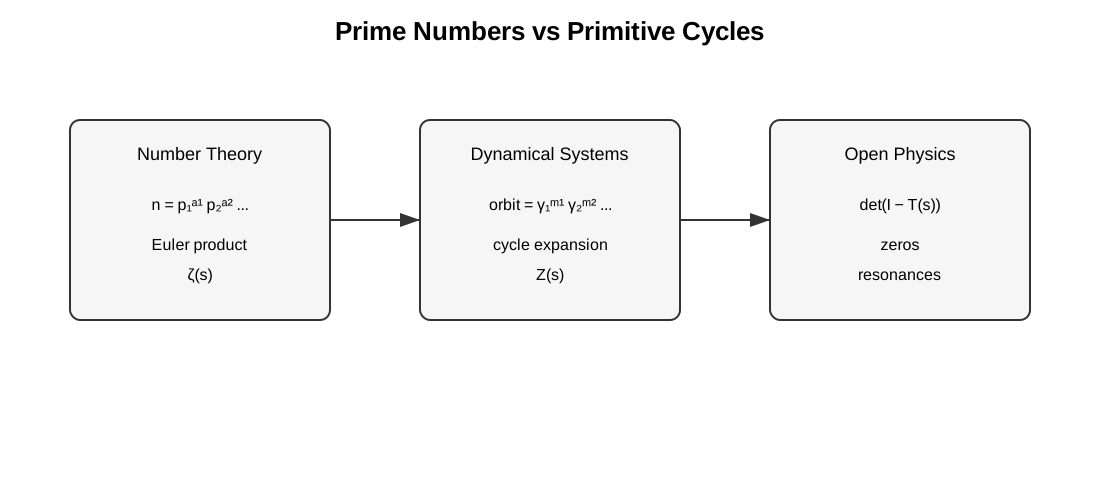
Proposition – Universal Zeta Structure
Proposition. Any open dynamical system with primitive cycles and multiplicative repetition structure naturally admits a zeta product representation.
The zeros of this function correspond to resonances of the dynamics.
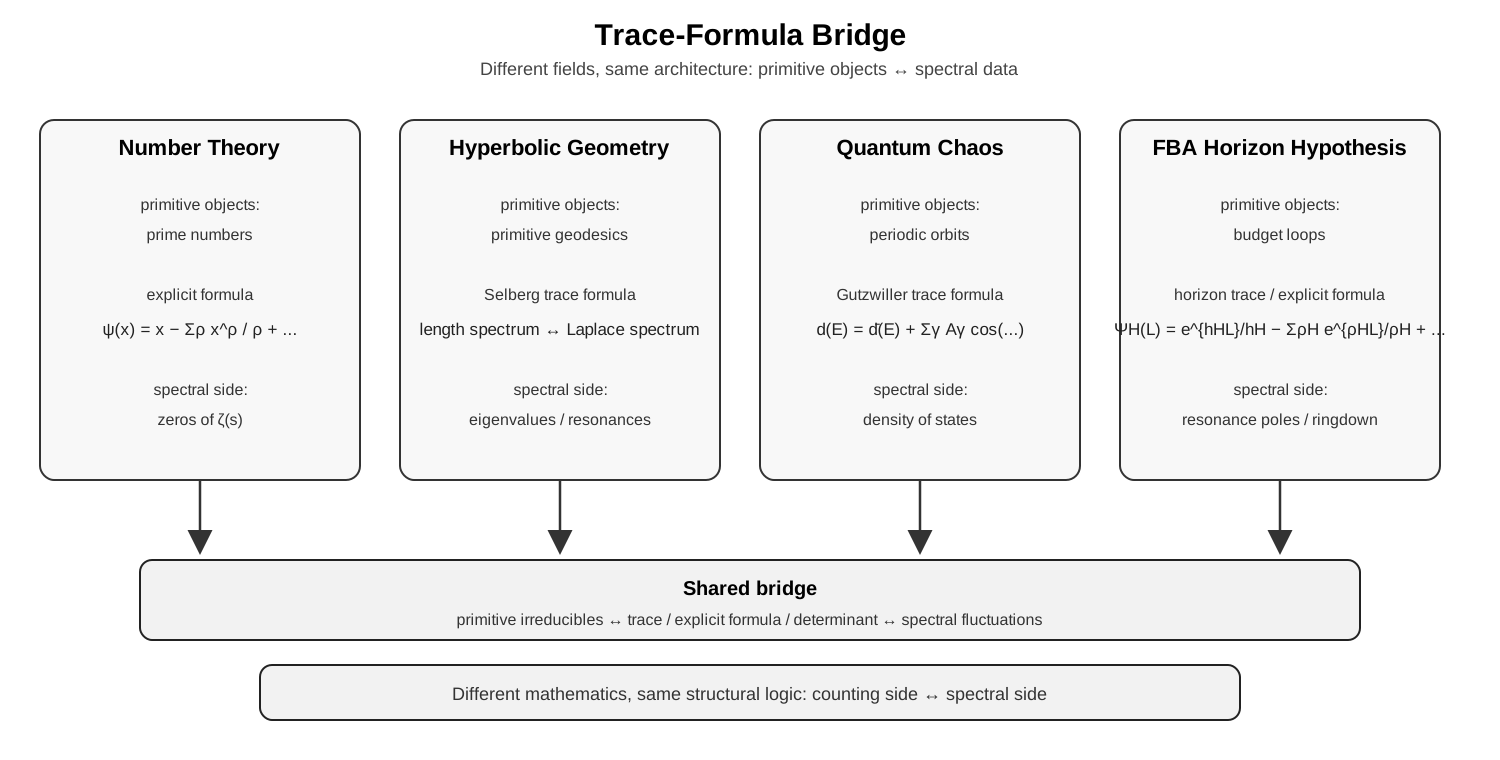
This observation underlies many results in number theory, hyperbolic geometry, and quantum chaos.
4. Determinants and Resonances
This relation connects primitive cycles directly to resonance spectra.
5. Interpretation within the Frame Budget Approach
- Primitive budget loops
Part I – visible in the PDF in
Section I.2 “Primitive assumptions of the FBA” and
Section I.3 “Budget calculus”, in particular the subsections on global states, frames, minimal events, refinement invariance, and one-step budgets. - Time structure
Part II – Definition II.3.1 “Time as strictly increasing embedding”
Definition II.4.1 “Geometric proper time”
Definition II.4.2 “Aging (irreversible contribution)” - Open dynamics
Part IV – Definition IV.3.2.1 “Quantum Markov semigroup”
Formula Box IV.3.2.1 “Generator of a CPTP semigroup”
Lemma IV.3.3.1 “GKLS equation” - Gravitational proxy
Part VI – Formula Box VI.3.1.1 “Curvature proxy from budget lapse”
6. Horizon Zeta (Toy Model)
7. Explicit Formula
8. Falsifiability
FBA references:
- Part X – Formula Box X.7.2.1 “Generic bridge falsification criterion”
- Part X – Formula Box X.10.2.1 “Bridge decision rule (binary) and goodness measure (continuous)”
References
- Hartnoll & Yang – The Conformal Primon Gas at the End of Time
- De Clerck, Hartnoll, Yang – Automorphic L-functions and complex primon gases
- Basu, Das, Krishnan – An analytic zeta function ramp at the black hole Thouless time
- Dyatlov, Guillarmou – Pollicott–Ruelle resonances
- Cvitanović et al. – Periodic orbit theory
- Frame Budget Approach – Parts I–X
Discussion
Zeta functions can be understood as compressed bookkeeping of irreducible cycles in open, irreversible dynamical systems.
In this perspective, black holes would not represent an exotic exception, but rather an extreme limiting case of a universal structural architecture.
Leave a Reply